Captain (Maj.) James H. Palmer, 151 Machine Gun Battalion, Company A Commander
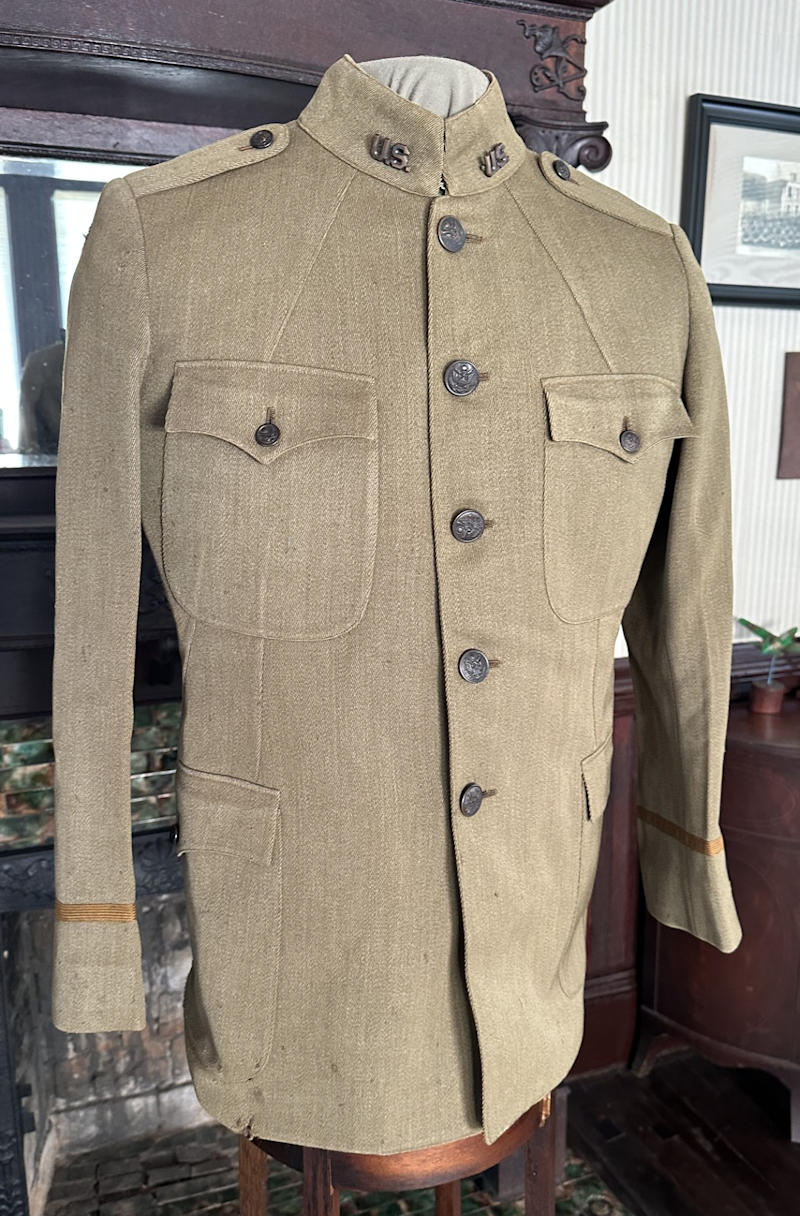 |
Above: Tunic from Major J.H. Palmer
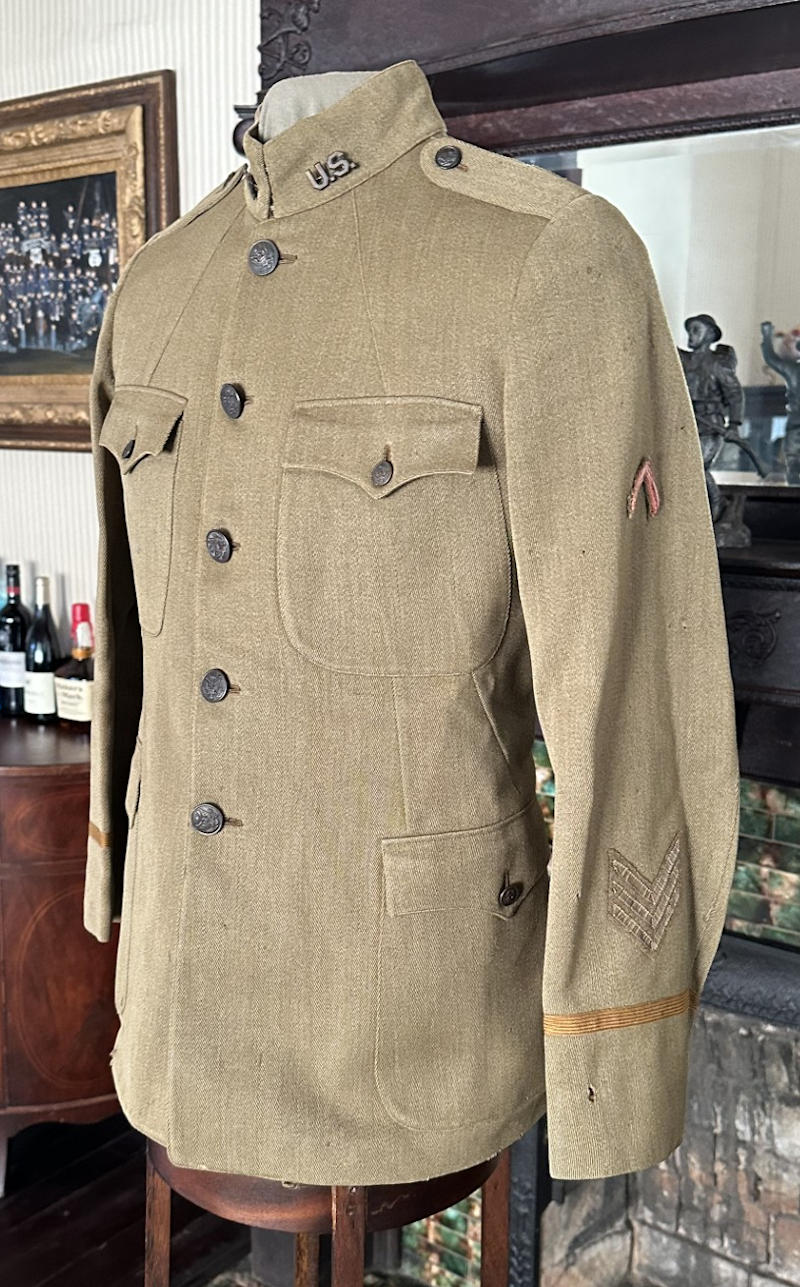 |
Captain (Maj.) James H. Palmer, 151 Machine Gun Battalion, Company A Commander
|
Above: Tunic from Major J.H. Palmer
|
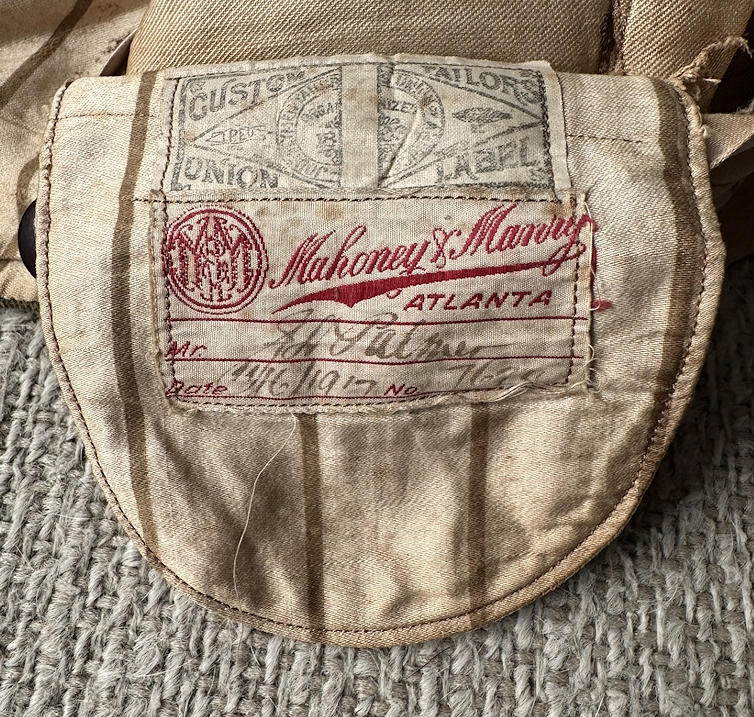 |
Above: Pants from Major J.H. Palmer marked Atlanta
.jpg) |
Above: Captain James H. Palmer transported onbaord the Agamemnon along with his 151st Machine Gun Compnay A from Hoboken NJ to France
.jpg) |
Above: Major James H. Palmer returns to the US from Brest, France with the 149th Machine Gun Battalion (PA National Guard). I assume he returned as their commander. The 149th MG Company B had been transfered to the 151st MG BN command and some of its PA National Guard offiers sent back to the US. There must have been other issues with the remainder of the PA battalion, considering Major Palmer was sent to this postion
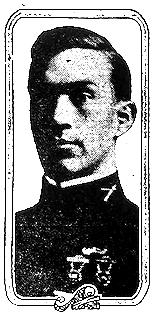 |
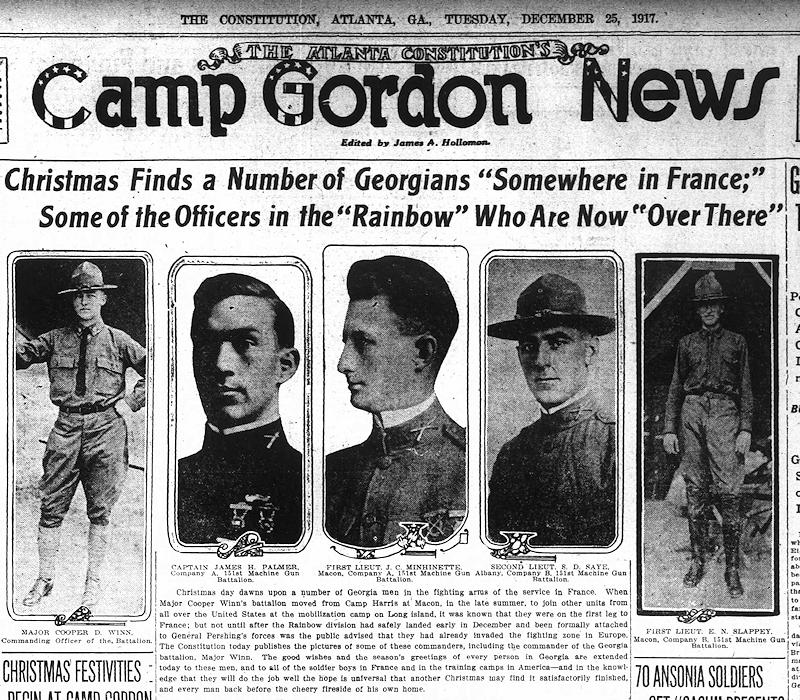
Above and below: Photograph of Captian James H. Palmer in the Atlanta Constitution newspaper Christmas day 1917
 |
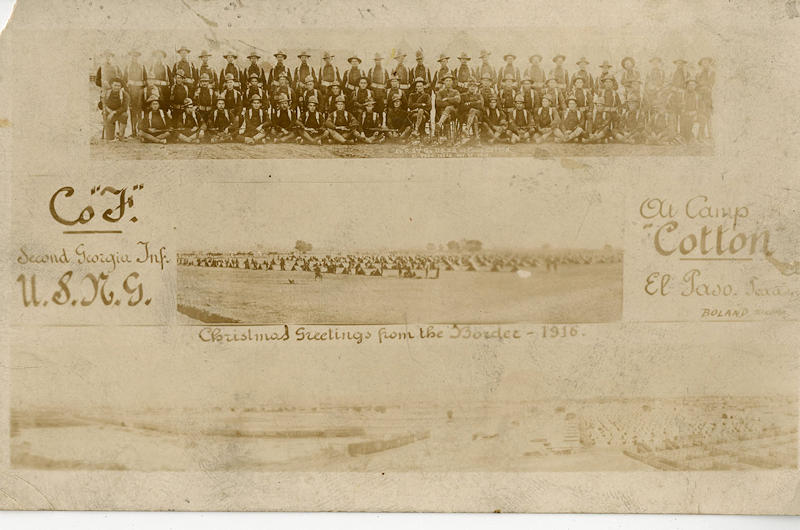 |
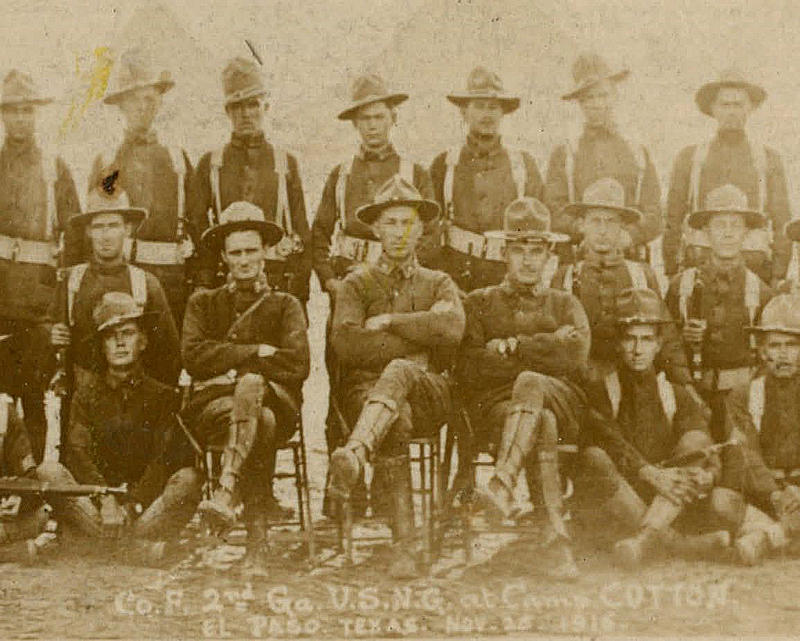
Above and below: Photograph of Captian James H. Palmer (seated center) with F Company at Camp Cotton, Texas
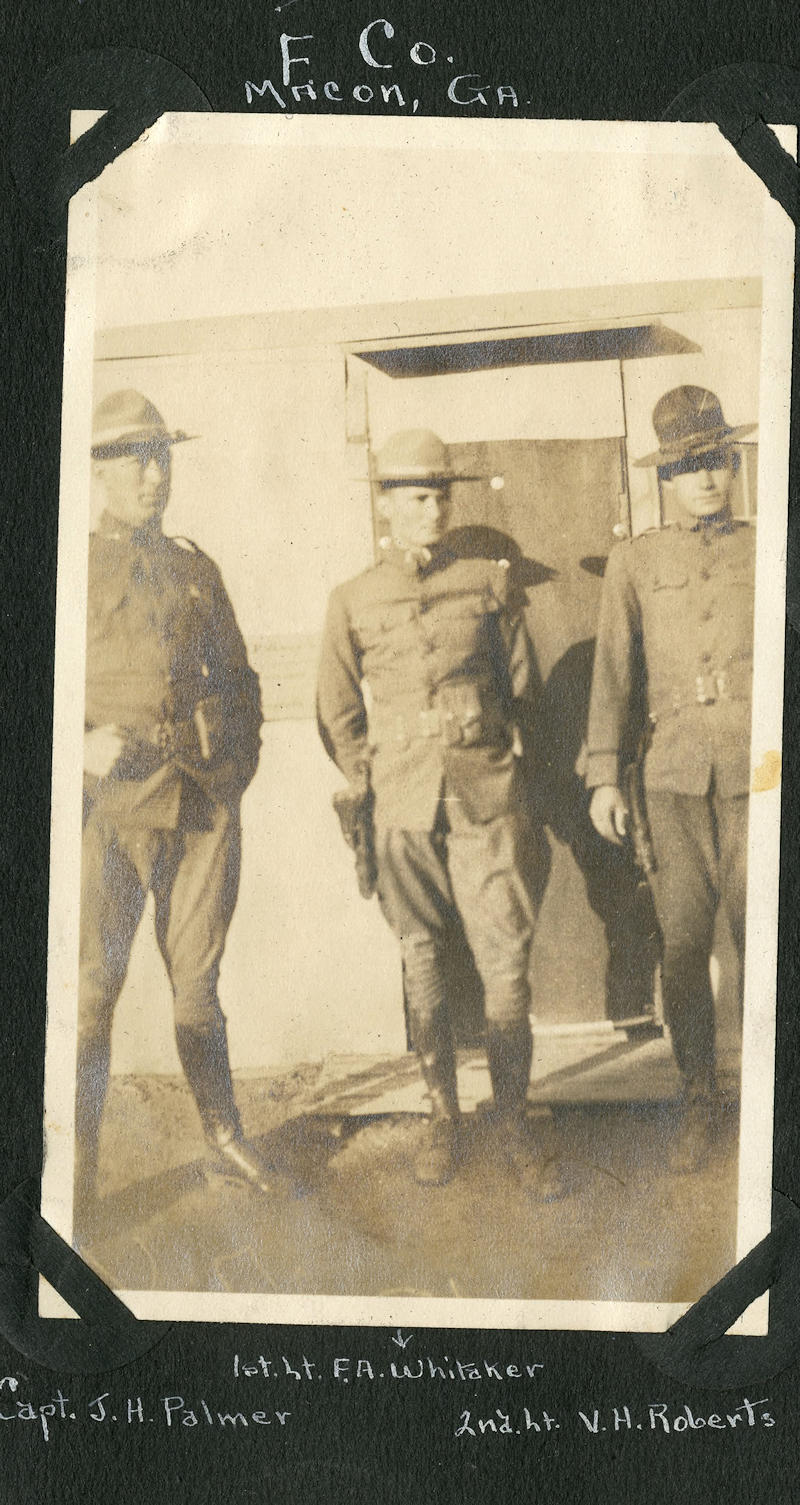
Above and below: Photograph of Captian James H. Palmer (Left) with F Company alongside 1LT Whitaker and 2LT Roberts in Macon, Georgia
 |
Thanks to Major William Carraway (Georgia National Guard Histroy Detachment) for sharing the photos of Captain Palmer
Major Cooper D. Winn Jr was named as commander of the 151st Machine Gun Battalion
when it was organized on August 1917 in Macon. From the beginning it was formed
to go to the composite division of the National Guard for service in Europe.
Because of the composition of National Guard Soldiers stretching from all over
the United States this division acquired the nick name "Rainbow Division".
With it is numbers filled out by men of the Georgia National Guard, the 21 officers
and 560 enlisted men of the 151st Machine Gun Battalion moved from Camp Harris
located near Macon, Georgia to the Division's training area at Camp Albert L.
Mills in Long Island, New York. The designations for the battalion's companies
changed from B, C and F Companies to A, B, and C with F becoming A Company.
At this camp, the battalion was introduced to new equipment and physical training.
The 151st Machine Gun Battalion went through two months of training before embarking
on the US Transport Agamemnon for deployment to France. The unit's personnel
strength was 25 officers and 545 enlisted men. The additional three officers
came from the Reserve Corps and another was a dental surgeon. The loss of fifteen
enlisted men were due to health issues.
There was little excitement onboard the Agamemnon as the unit was transported
to France. Only one episode stands out where the ship stuck the Von Stuben (one
other US ship of her convoy) with only minor damage. The Agamemnon anchored
in harbor November 12, 1917 at Brest France, which is one of the western most
points in France. Due to lack of accommodations and transport issues the battalion
was not off loaded until November 17. Once on French soil, they were quickly
put onboard a French freight train with horse/cattle cars. This was almost a
universal experience for the US soldier in WW1, which is always described with
great discomfort and lack of rations. These cattle cars were typically marked
"40/8" for 40 men/8 horses, which is where the American Legion's separate
organization "La Societe des Quarante Hommes at Huit Chevaux" gets
its name.
By November 21, the battalion had traveled almost the full length of France
from west to east when they arrived at Vaucouleurs France. Vaucouleurs is fairly
near Nancy, Metz and the front trench line with Germany. Once at Vaucouleurs,
Headquarters, A and B Companies marched to Uruffe and C Company to Vaux La Petite.
After the very long and difficult railway transport these marches with heavy
packs in pouring rain were a significant hardship. The battalion trained in
the Vaucouleurs area until December 12, 1917 when the 42nd Division Commander
ordered the battalion's movement to the Rolampont Area. This was a 110 kilometer
(69 mile) march, again with heavy packs but on this occasion a snow storm was
ongoing. The battalion assembled at Manois (50 km North of Rolampont) and remained
in this area through Christmas of 1917. Following Christmas, the battalion marched
to several small towns spread out over about 30 km between Blancheville and
Chaumont. While the unit was training in this area their organization was altered
by the addition of one company. Surprisingly, this addition came from Pennsylvania
National Guard and was originally raised as the 4th Pennsylvania Infantry and
later transformed into the 149th Machine Gun Battalion Company B (It initially
retained this designation even after the re-organization). The odd combination
of Southerners lead by a battalion commander, whose grandfather was killed at
Gettysburg commanding 4th Georgia Infantry, now with a company of Pennsylvania
Infantrymen, no doubt lead to some interesting comments. (See
Sergeant John C. Kiehl's Diary) Despite the differences, these units
at least had the experience of service on the Mexican Border in 1916 in common.
By January 4, 1918 the full battalion with four companies went into more or
less permanent billets at Villers sur Suize (Haute Marne). During their five
weeks at this location the battalion finally received French Hotchkiss Machine
Guns, steel helmets and gas mask plus final training to prepare the men for
entering the trench line.
Between February 18 and 22,
1918 the companies of the battalion moved by rail to the area of Givrillers.
The 167th Infantry (Alabama National Guard) was augmented by 151st Machine Gun
Battalion's A and B Companies. The 168 Infantry (Iowa National Guard) was augmented
by C Company and B Company of 149th MG. Major Cooper D. Winn Jr. moved up to
Brigade level and served as the 84th Brigade's Machine Gun Officer.
On March 8, companies of 151st Machine Gun Battalion began entering first line
trenches in the vicinity of Badonvilliers and Ancervillier, working with a combination
of US and French Infantry units. Each company of the battalion made one tour
of the front line during this time that 42nd Division occupied the sector (under
the command of the French 128th Infantry Division and French 6th Corps). It
was noted that in this time frame Company C conducted indirect (barrage fire)
in support of a raid by 168th Infantry. The 151st Machine Gun Battalion only
suffered three casualties during this first experience in the trenches. Two
of these men were only slightly wounded and the third severely. This man later
died of wounds. By March 23, the entire division's tour ended along the front
line. Units marched to small towns like Rambervillers to the rear of their former
positions. From this point the battalion entered the Rolampont Area for additional
equipment and further training before moving a more active sector. On March
28 Company B, 149th Machine Gun BN was re-designated as D Company, 151st Machine
Gun Battalion.
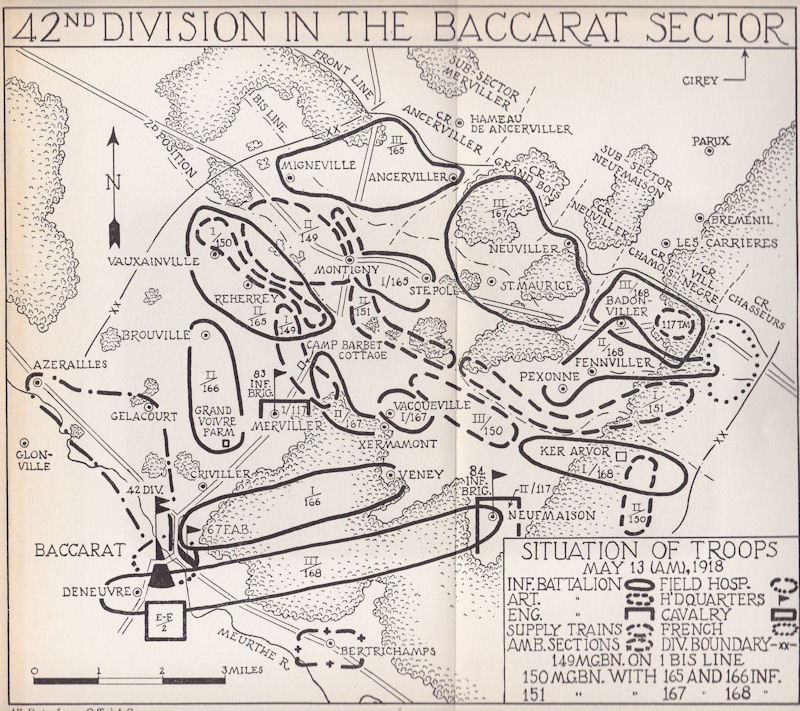 |
The battalion received orders to again move to the front line of the Baccarat Sector and again, A and B Companies were attached to 167th Infantry and C and D Companies were attached to 168th Infantry. The trenches and dugouts for the machine gun units had been previously occupied by French units. They had not been well maintained and the Americans were unable to gain permission to make improvements until much later in their tour. On May 27- 28, C Company along with 168th Infantry sustained a prolonged German chemical gas projector attack. Company C performed particularly well, assisting to repulse a German Infantry raid coordinated with the gas attack. Company C's gas warfare training was seen to pay off too. They only took three casualties verses 200 sustained by the 168th Infantry Battalion located in the same area. Later one single platoon of C Company took over machine gun positions in the area of C.R. Chamois which were previously occupied by a full Machine Gun Company of 165th Infantry. In June, with their tour nearing an end, the 151st Machine Gun Battalion sustained the most harsh gas projector attack in their experience to that point. This attack resulted in 24 casualties in Company D (old CO. B, 149th MG).
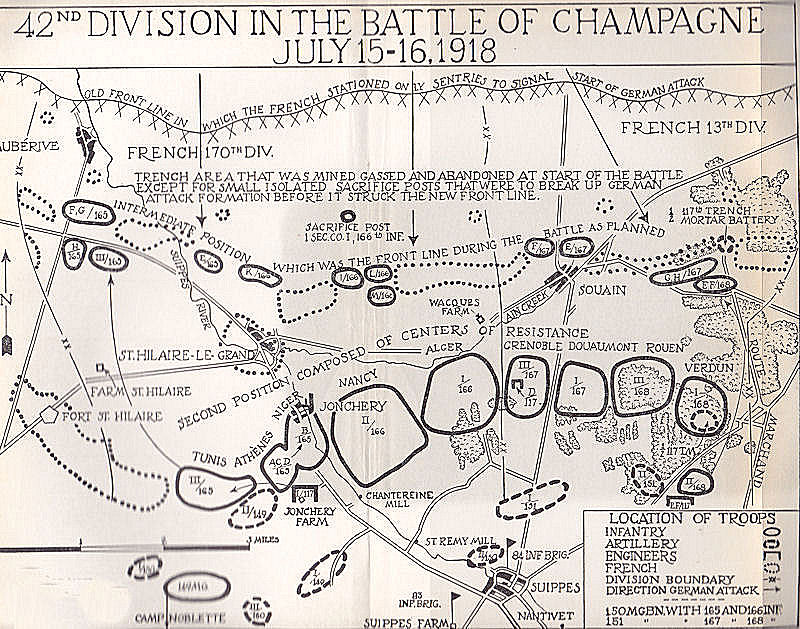 |
In late June 1918, the 151st Machine Gun Battalion conducted training in rear areas away from the trench line. Unexpectedly, a change in conditions at the front lead to orders for the 42nd Division to prepare for a minor offensive action. This was along with two French Divisions in the vicinity of Champagne front lines. In this action, 42nd Division served as a subordinate of the French 4th Army commanded by General Gouraud. July 4, 1918 the 151st Machine Gun Battalion arrived in Suipes and was again broken up to support the infantry battalions. Companies A and B took up positions in the Esperance-Souain Sector with 167th Infantry Battalion. Company D moved to the same sector and was held in reserve supporting the 168th Infantry Battalion. After two false warnings of an enemy attack late on the night of July 14, the French Headquarters reported intelligence predicting a German offensive would begin at midnight. American and French Artillery commenced preparatory fires on the German lines just as this warning went out. The men of the 42nd Division barely had time to get to the limited dugouts before the German Artillery HE and chemical gas barrage began. Because of the limited room in the dugouts, many of the men stayed in wooden frame barracks or stayed on duty manning their gun positions. This barrage resulted in considerable casualties in the battalion. Certainly this must have been deeply frustrating to the men of 151st Battalion especially considering they had no weapon available to them that could counter-fire onto the enemy artillery positions. During the barrage, Company C took particularly heavy casualties and had no cover for their mule carts, consequently all were destroyed. During the barrage from the night of the 14th to the 16th of July the men of the battalion had no food available to them except their reserve rations. On the late night and morning of the 18th and 19th the battalion received orders to move fifteen kilometers distant to Camp Noblotte. This move was accomplished by foot march under heavy enemy artillery fire. From there, the battalion made their way by a combination of marching and buses to Bois de Fere, north of Courpoil. They relived elements of the US 28th Division. As the battalion entered the front line they were parceled out in the same manner as before to the infantry. Company B and C fought in the vicinity of Croix Rouge Farm, making their way through thick woods along with the infantry they supported. Both met their objectives for the day but it was felt that the machine gun units added little value to the infantry in this type of fight. It is important to understand that the 151st MG Battalion's Hotchkiss Machine Guns were very heavy and preformed best when they were emplaced in over-watching positions. They were not well suited to quick movement in rough terrain.
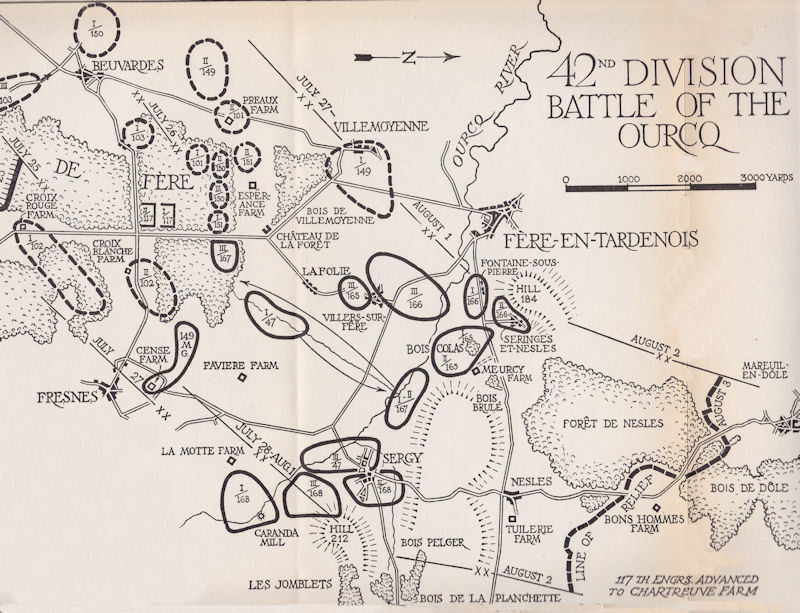 |
The 151st Machine Gun Battalion was a part of the 84th Brigade. On August 6, 1918 Brigadier General Douglas MacArthur took command of the 84th Brigade. He immediately reorganized the machine gun battalions to fight under their own command as separate units no longer parceled out to the infantry battalions. Major Cooper D. Winn Jr. then moved from serving as the brigade level machine gun officer to direct command of his own battalion. It is obvious that both Brigadier General MacArthur and Major Winn expected better results from the heavy machine gun units if they were employed in concentrated over-watching or indirect fire positions. This usage of the machine gun is somewhat peculiar to the WW1 Era.
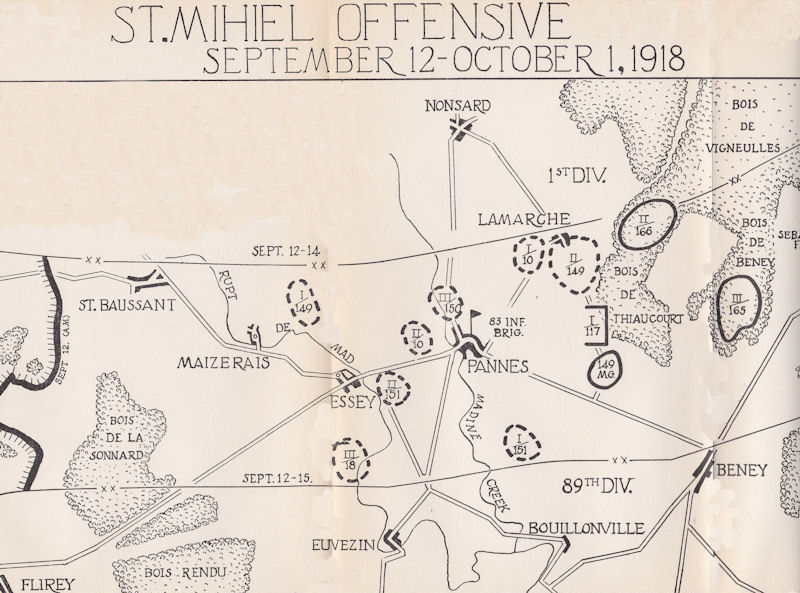 |
September 8, 1918 the 151st Machine
Gun Battalion moved to conealed positions within the forest in the vicinity
of Siechprey. Here Major Cooper D. Winn Jr. received orders for the St. Mihiel
Offensive . The 151st Machine Gun Battalion would fight as a separate command
under the 84th Brigade on the right flank of the 42nd Division. On the 10th
of September Major Winn and his four company commanders reconnoitered the
planned assembly area for the assault. While there, these officers located
existing emplacements and prepared their machine gun fire plan. The following
day the battalion moved in heavy rain to the jump-off point along the front
trench line. The combat trains remained in covered positions near Mandres
while the battalion command post was set up just behind the jump-off trench
line. At 1:00 PM a preparatory Field Artillery barrage began. Four hours later
the infantry advanced with tank support. The 151st Machine Gun BN provided
an indirect fire barrage coordinated with this assault. The 151st MG BN bounded
forward once the first wave of infantry reached the objective. The combat
trains having provided good supplies of food and ammunition during the assault
now moved forward and supported the battalion from Essey.
Cooper D. Winn Jr's wife, Claudia received a letter from her husband dated
September 15, 1918. He summarized the extraordinary difficulties his men overcame
daily and expressed the enormous stress of leadership in such conditions.
He mentions the 200 replacement troops dumped on his command plus issues of
getting food to the battalion from field kitchens over miles of roads made
almost impassable by mud. In another paragraph, he describes nursing his horse
back to good health only to have it killed by shell fire. Throughout it all,
he kept his sense of humor and compassion. He recounts in somewhat comic terms
shell fragments striking his head. He joked to his wife that "At least
I am still lucky…they just picked hard spots on me". He mentioned
that French children reminded him of their own son (Cooper D. Winn III). He
also expressed great pride in the 151st.
To make the advance though the Argonne, 42nd Division was placed under the
command of Fifth Corps. The 151st Machine Gun BN received orders to move to
positions near Exermont. It was expected that the battalion would simply occupy
positions previously used by machine gun troops of 1st Division's, 2nd Infantry
Brigade. Because these units fought with their companies parceled out to the
infantry, the positions were not suitable for 151st MG BN, now serving as
a separate unit. The 151st Machine Gun BN instead choose their own firing
positions. Companies B and D occupied an area near Hill 263 under heavy shell
fire and Companies A and C remaining in the reserve. Combat trains held at
Eclis Fontaine. Once emplaced, the battalion received orders to deliver a
protective barrage in support of 84th Brigade's Infantry assault on the German
defense position "Kriemhilde Stellung". All the 151st Machine Gun
BN officers participated in a reconnaissance of Hill 263. Locations were selected
for all the Hotchkiss machine guns. Each had an excellent over watching view
of the terrain to be covered by the infantry with clear fields of fire over
the trenches as far back as St. Georges. Artillery preparatory fire began
after 5:00 PM on October 13, 1918. That same evening the 151st Machine Gun
BN occupied Hill 263 and dug in the machine guns. Just enough men to serve
as crew stayed with the guns. The remaining men took cover behind the hill.
In that way, as casualties were taken these men under cover could be called
on as replacements.
On October 14, 1918, just before the infantry assault on the Cote de Chatillon
defensive works, 151st Machine Gun BN began their preparatory barrage. The
infantry assault started at 0800 A.M. and the 151st Machine Gun BN's supporting
fires continued. With a tremendous volume of enemy machine gun fire directed
at the attacking infantry, this assault faltered. The American artillery and
machine gun predatory fires had failed to break the German defense. A second
attack on the same position pushed forward. This time there was evidently
no artillery preparatory fire but only the fires from all the Hotchkiss machine
guns of the 151st. From the description in the battalion history, it sounds
like the 151st Machine Gun BN changed their technique a bit. "Moving
Barrage" fires over the heads of the advancing infantry suppressed the
enemy riflemen and machine gunners until the friendly infantry was on top
of the enemy defensive positions. This time the assault on Cote de Chatillon
was successful. Once the former enemy defensive works were occupied the troops
of the machine gun battalion assisted the infantry in rebuilding the Cote
de Chatillon defenses for their own use.
The use of massed "Moving Barrage" machine gun fires as a technique
proved itself in the attack on Cote de Chatillon. As a result, the Fifth Corps
commander called for a conference of all his machine gun battalion commanders
to better educate them in this technique.
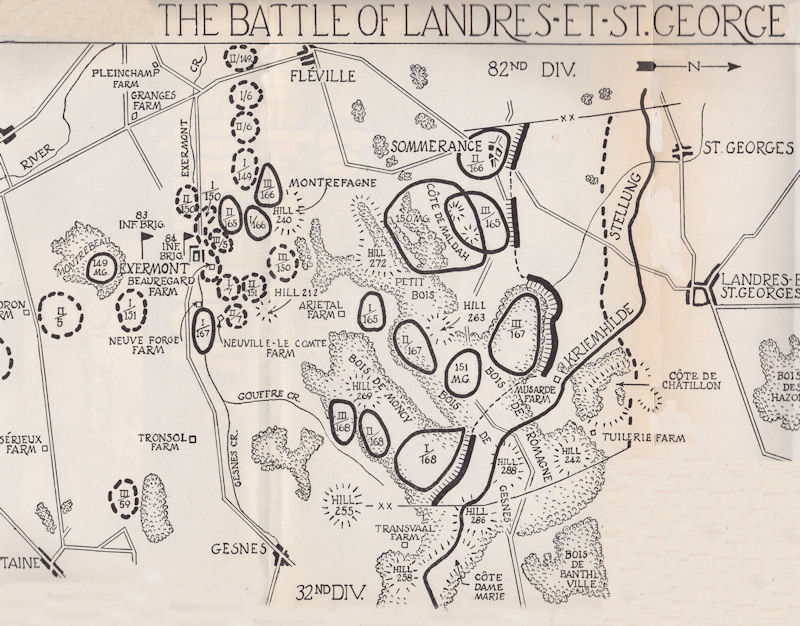 |
The battalion expected to push forward from their positions at Cote de Chatillon but orders which likely came from Corps level changed this. The 42nd and the 2nd Divisions were ordered to take the enemy line running north of Landres St. Georges. The effects of both divisions' machine gun troops were massed for the attack. The same techniques employed by 151st Machine Gun BN against Cote de Chatillon were used on a larger scale against this new objective. The 151st along with the other machine gun battalions fired a continuous predatory barrage before the infantry attack. As the attack pushed forward these fires shifted, firing over the heads of the advancing infantry then moving with the rounds impacting just ahead of these troops until the objective was taken. When the 2nd Division's troops advanced beyond the range of the 151st Machine Gun BN's guns, the battalion was free to move to a quiet bivouac area in Exermount.
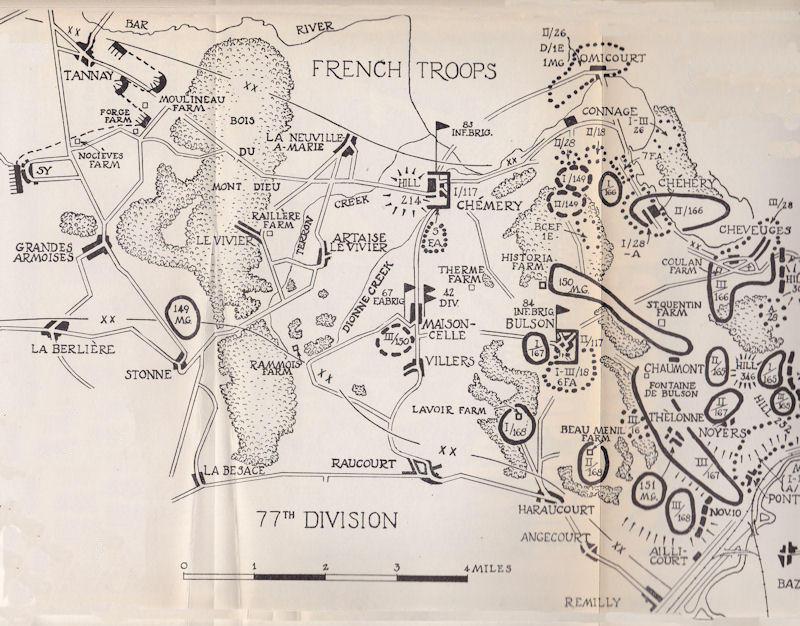 |
On November 9 the battalion was relived
from the line and assembled at Granges Armoises. The Armistice on November
11 brought an end to active fighting along the Western Front and the battalion
reassembled at Brandeville. By the 20th of November, 1918 the battalion was
re-equipped and given new uniforms and draft animals for their move into Germany.
All images, research, and text are sole property of Ralph Lovett.